

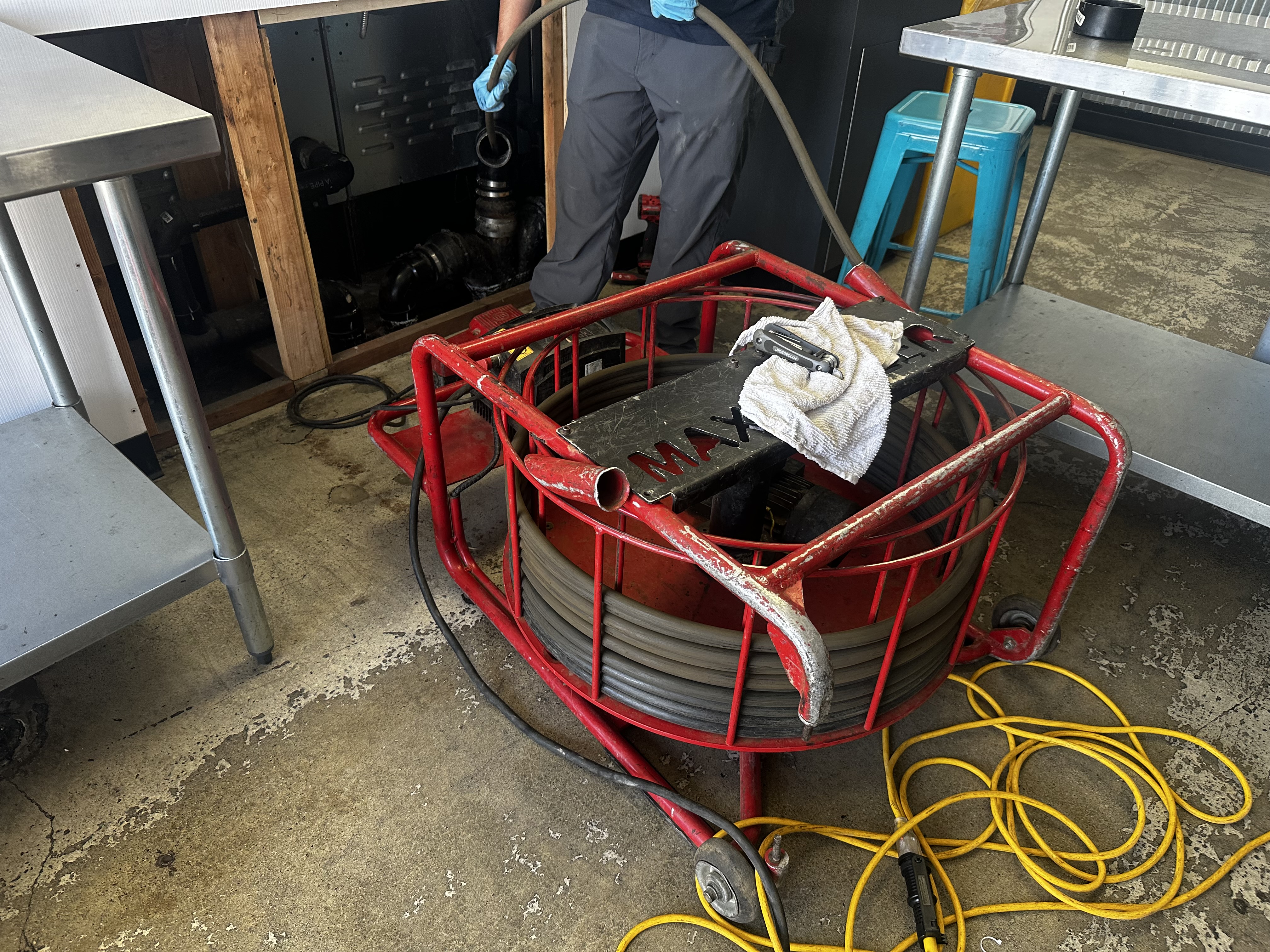
Hydro jetting is one of the most effective ways to clean drain and sewer lines. High-pressure water can remove grease, flush debris, loosen buildup, and restore flow through a clogged pipe.
But sometimes, even after several passes with a hydro jetter, stubborn material remains attached to the inside of the pipe.
That's when another cleaning method, called mechanical descaling, may be appropriate.
So what's the difference between hydro jetting and descaling, and how do you know which one your drain needs?
Hydro jetting cleans and flushes material using high-pressure water. Descaling uses mechanical action to loosen hardened buildup that water alone may not remove.
Both methods can improve drainage, but they accomplish different things. Sometimes, the best approach involves using them together.
What Does Hydro Jetting Remove?
Hydro jetting uses high-pressure water and specialized nozzles to clean the interior of drain and sewer pipes.
Depending on the condition of the line, it can remove grease, sludge, lint, sediment, loose scale, and other accumulated debris. Specialized nozzles can also cut or trim roots that have entered a drain.
Unlike conventional power snaking, which often opens a path through a blockage, hydro jetting can flush loosened material out of the pipe.
However, high-pressure water has limitations.
Older cast-iron drains, in particular, can develop hardened scale and rough deposits along their interior walls. Some of this material may loosen during hydro jetting, while other deposits remain firmly attached.
We may make multiple passes with the hydro jetter to remove as much material as reasonably possible. But when hardened buildup remains, continuing to spray water may not accomplish much more.
That's when we consider whether mechanical descaling would provide additional value.
How Is Descaling Different?
Think about washing dishes.
Spraying a dirty pot with water removes loose food and residue. But stubborn material stuck to the surface often requires scrubbing.
Drain cleaning can work much the same way.
Hydro jetting provides the washing and flushing action. Mechanical descaling provides the scrubbing action.
Descaling equipment physically works against hardened buildup inside the pipe, loosening material that high-pressure water may not adequately remove.
This can be particularly useful in older cast-iron drains where scale has accumulated over many years, narrowing the usable opening and creating rough surfaces that catch debris.
But descaling isn't simply a stronger version of hydro jetting. It's a more aggressive mechanical process that requires additional care, particularly when working with deteriorated pipes.
Can Hydro Jetting and Descaling Work Together?
Absolutely. In fact, the two methods often complement one another.
We typically begin by understanding the condition of the drain through its service history, camera inspection, and cleaning results.
Hydro jetting may be used first to remove loose debris and buildup. If camera inspection reveals substantial hardened material remaining inside the pipe, we can evaluate whether mechanical descaling is appropriate.
During descaling, the equipment loosens material from the interior walls.
But that loosened material still needs to go somewhere.
Just as you rinse a car after scrubbing it, we almost always use hydro jetting to flush away debris loosened during descaling.
The process may require several passes, alternating mechanical cleaning with flushing.
Whenever practical, we use a sewer camera afterward to verify the results and evaluate the remaining condition of the pipe.
The objective isn't simply to use more equipment. It's to improve the usable opening of the drain while preserving the existing pipe as much as reasonably possible.
A Laundromat Drain in El Segundo
We recently worked with a laundromat in El Segundo where the drain wasn't experiencing an active backup.
However, an inspection revealed years of accumulated debris inside the cast-iron drain line, including old coins that had become lodged in the pipe.
Hydro jetting was effective at removing accumulated lint, soap residue, and other loose material.
But the coins were a different problem.
Some had become firmly stuck inside the cast-iron pipe, and high-pressure water alone couldn't dislodge them.
We used mechanical descaling to help loosen the embedded coins and other stubborn material. Multiple passes with the hydro jetter then helped sweep much of that debris out of the drain.
Not everything came out. Some coins remained attached to the cast iron.
But the improvement was substantial.
The drain went from approximately 35% obstructed to almost fully restored flow.
The goal wasn't necessarily to remove every last coin. It was to restore the drain's ability to carry wastewater effectively while preserving as much of the existing pipe as possible.
This is a good example of why hydro jetting and descaling aren't competing methods. Each accomplished something the other couldn't do as effectively.
Is Descaling Safe for Older Cast-Iron Pipes?
This is an important consideration.
Cast-iron pipes deteriorate over time. Corrosion, scaling, and other conditions can weaken the pipe walls, sometimes leaving sections that are more fragile than they initially appear.
Because descaling mechanically works against the interior of the pipe, it can damage cast iron that has already deteriorated.
We use camera inspection to evaluate the condition of the drain before recommending descaling whenever possible. But even with an inspection, we cannot always determine how well an older pipe will withstand the process.
Sometimes the extent of deterioration only becomes apparent as material is removed.
That's why we discuss the risks with customers before proceeding.
Descaling can fail to achieve the intended results, and deteriorated pipes can break during the process.
Our responsibility is to explain what we're trying to accomplish, what limitations exist, and what additional steps might become necessary if the pipe cannot withstand cleaning.
We work carefully to preserve the existing pipe while achieving the agreed-upon objectives.
In some cases, that means limiting the mechanical cleaning. In others, the pipe's condition may make descaling inappropriate altogether.
When Is Cleaning No Longer Enough?
Neither hydro jetting nor descaling can correct every drain problem.
Hydro jetting can remove and flush accumulated material. Descaling can mechanically loosen hardened buildup and improve the usable opening of a pipe.
But neither method can reliably correct a broken pipe, significant structural deterioration, an offset connection, or an improperly sloped drain.
And sometimes material is simply too firmly attached or the pipe too deteriorated for further cleaning to be practical.
That's when we may need to discuss other options, including pipe rehabilitation or replacement.
Finding these conditions doesn't automatically mean replacing the entire drain. The appropriate solution depends on the location and extent of the problem, the condition of the remaining pipe, and how the system needs to perform.
The important part is understanding what cleaning can reasonably accomplish—and when another approach makes more sense.
Choosing the Right Drain Cleaning Method
There isn't one cleaning method that's best for every drain.
Power snaking can open a blockage. Hydro jetting can clean and flush accumulated material. Mechanical descaling can loosen hardened buildup that water alone cannot adequately remove.
Sometimes one method is sufficient. Sometimes several methods work together.
For homeowners, businesses, and property managers throughout the South Bay, the decision should start with understanding the drain—not simply choosing the most aggressive cleaning method available.
We want to know what's inside the pipe, what condition the pipe is in, and what results we can reasonably expect.
That means inspecting when possible, selecting the appropriate cleaning process, verifying the results, and explaining any remaining limitations.
The goal isn't necessarily a perfectly clean pipe. It's a drain that performs as intended, with a clear understanding of its condition and what may be needed next.
Published: November 13, 2026
Last reviewed: November 13, 2026
South Bay Drain Guide | Zoom Drain Los Angeles
Practical drain and sewer guidance for South Bay homeowners, businesses and property managers.