

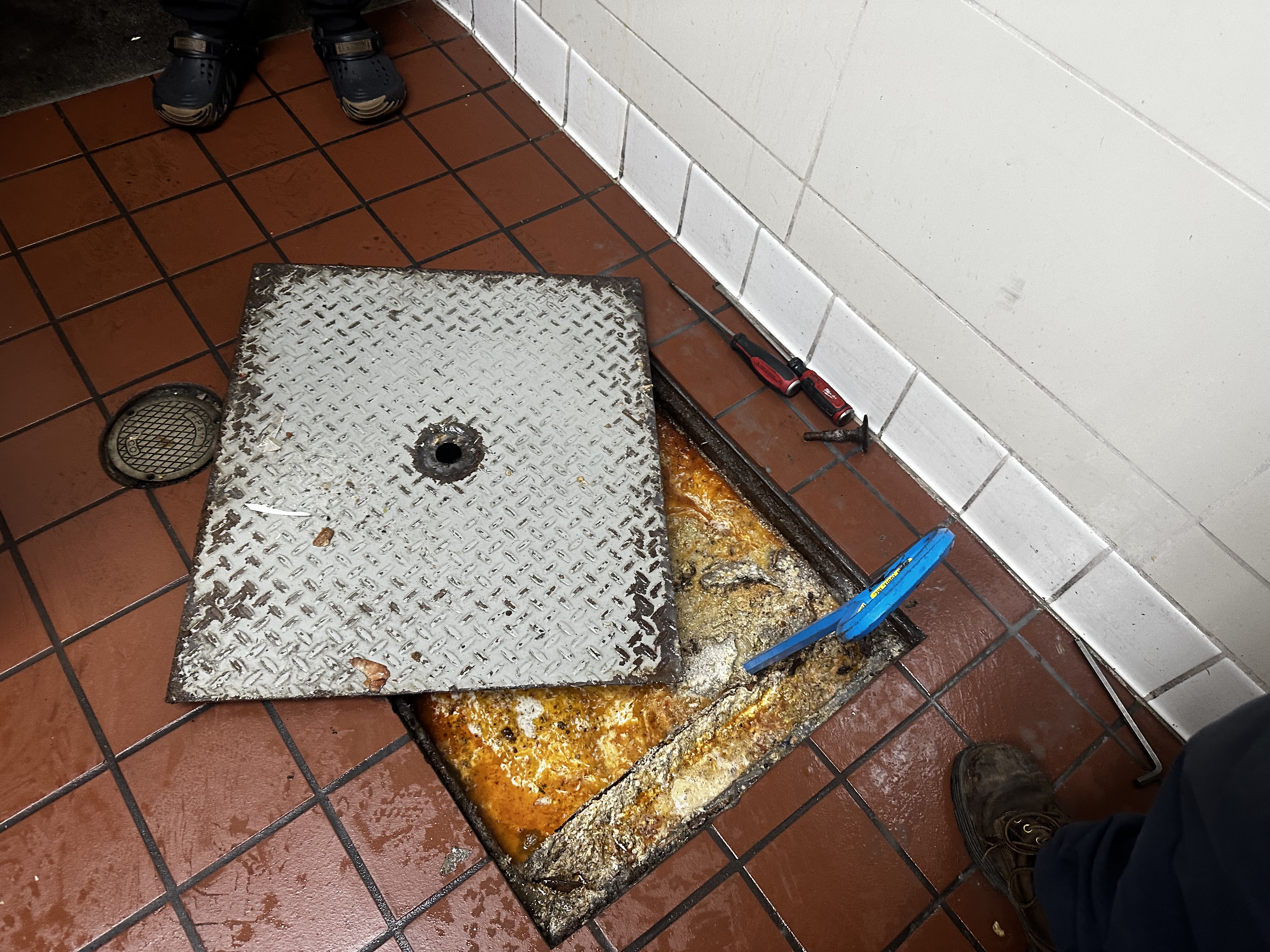
A restaurant floor drain starts overflowing during a busy shift. Wastewater spreads across the kitchen floor, and normal operations are interrupted.
The backup may seem sudden, but the problem often develops over time. Grease, food waste, and other debris gradually accumulate inside drain lines. Warning signs, such as slow drainage or occasional minor clogs, may go unnoticed until the system backs up.
The immediate priority is restoring operations. The longer-term goal is understanding why the backup happened and preventing it from happening again.
What Causes Restaurant Drain Backups?
The most common restaurant drainage problems we encounter involve kitchen floor drains and grease interceptors.
Grease buildup is the leading cause. As grease travels through drain lines, it can accumulate along the pipe walls and gradually restrict flow.
Food solids and debris also contribute to blockages. We've encountered everything from food particles to cork fragments and pieces of scrub pads.
Pipe conditions, including poor slope or damaged sections, can make these problems worse by allowing material to accumulate.
Every restaurant is different. Drain configurations, kitchen operations, and fixture usage all influence where problems develop.
Understanding those conditions helps us determine what caused the backup and how to address it.
Restore Operations First, Then Address the Cause
Most restaurants call when there's already an emergency—an overflowing floor drain, a clogged kitchen sink, or wastewater backing up into an active work area.
Our first priority is to relieve the obstruction and restore operations as quickly as practical.
Power snaking is often our initial approach because it can open a blockage without the additional setup and disruption associated with more extensive cleaning.
Once the immediate problem is resolved, we can determine whether further work is appropriate.
Hydro jetting can remove accumulated grease and debris from drain lines, while camera inspection helps identify conditions contributing to recurring problems.
Because these procedures require additional time and coordination, they're often scheduled during slower periods or after business hours.
Emergency cleaning restores flow. Follow-up cleaning and inspection help address the conditions that could cause another backup.
Cleaning a Grease Interceptor Doesn't Clean the Drain Lines
This is one of the most important distinctions for restaurant operators to understand.
A grease interceptor collects grease that has already traveled through the kitchen's drainage system.
Before reaching the interceptor, grease passes through the drain lines connecting sinks, floor drains, and other fixtures. Some of it accumulates inside those pipes along the way.
Pumping the interceptor removes collected grease and waste, but it doesn't clean buildup attached to the upstream drain lines.
That's where hydro jetting can play an important role.
By flushing accumulated grease and debris from the drain lines, hydro jetting helps address restrictions before they cause another backup.
Grease interceptor pumping and drain-line cleaning serve different purposes. Both are important parts of maintaining a restaurant's drainage system.
A Restaurant Backup in Redondo Beach
We recently responded to a restaurant in Redondo Beach where multiple kitchen floor drains were overflowing.
The restaurant needed immediate relief so normal operations could resume.
During our investigation, we found grease-filled wastewater backing up through the floor drain basins. Further inspection revealed that the outdoor grease interceptor was full and backed up.
Our first step was to pump out the accumulated grease and waste from the interceptor.
That relieved the backup and allowed the kitchen floor drains to flow again.
But restoring flow wasn't the end of the work.
We subsequently performed hydro jetting on the drain lines leading to the interceptor. This flushed out a substantial amount of additional grease that had accumulated inside the piping.
The loosened grease was collected in the interceptor and pumped out.
The difference was important.
Pumping the interceptor resolved the immediate backup. Hydro jetting addressed grease buildup in the drain lines that carried wastewater to it.
With both portions of the system serviced, the restaurant had a better starting point for establishing an appropriate maintenance schedule.
Rather than waiting for another overflow, the operator could begin planning service around the demands of the kitchen.
How Often Should Restaurant Drains Be Cleaned?
There isn't one maintenance interval that works for every restaurant.
A busy kitchen producing substantial amounts of grease and wastewater may require more frequent service than a smaller operation with lighter use. Seasonal changes in business volume can also affect how quickly buildup develops.
For many restaurants, quarterly or semiannual drain cleaning provides a reasonable starting point for preventative maintenance.
But the interval should be adjusted based on actual conditions.
We consider the restaurant's operating volume, previous cleaning history, the amount and type of material removed, and whether drainage problems have occurred between visits.
If a line repeatedly accumulates grease before its next scheduled cleaning, the interval may need to be shortened.
If the system remains relatively clean and performs well, a longer interval may be appropriate.
Grease interceptor pumping should also follow applicable local requirements and the interceptor's actual operating conditions. Its service schedule may differ from the drain-cleaning schedule.
The objective isn't simply to clean on a calendar. It's to establish a maintenance program that keeps the drainage system functioning reliably while minimizing interruptions to the restaurant.
When Is Cleaning Not Enough?
Sometimes recurring backups reveal problems that maintenance alone cannot correct.
A drain line may have insufficient slope, a damaged section of pipe, or another physical condition that encourages debris to accumulate.
Hydro jetting can remove grease and buildup, but it cannot correct the alignment or structure of the pipe itself.
If problems continue despite appropriate cleaning, camera inspection and additional diagnosis may help identify whether repair or rehabilitation should be considered.
That doesn't automatically mean replacing the entire drainage system.
The appropriate recommendation depends on what we find, how the system performs, and how significantly the condition affects restaurant operations.
Prevent the Next Backup Before It Interrupts Business
Restaurant drain backups are disruptive, especially when they affect the kitchen during operating hours.
Fortunately, many recurring problems can be addressed before they become emergencies.
Pay attention to slow drains and repeated minor stoppages. Maintain grease interceptors and the drain lines feeding them. Schedule more extensive cleaning and inspection when they can be performed with minimal disruption.
Most importantly, use the findings from each service visit to improve the maintenance plan.
At Zoom Drain Los Angeles, our approach is to restore flow when there's an emergency, investigate recurring problems, and help restaurants establish practical maintenance schedules based on their actual drainage systems.
The goal isn't simply to clear today's backup. It's to keep the drains working so the restaurant can focus on serving its customers.
Published: November 20, 2026
Last reviewed: November 20, 2026
South Bay Drain Guide | Zoom Drain Los Angeles
Practical drain and sewer guidance for South Bay homeowners, businesses and property managers.