

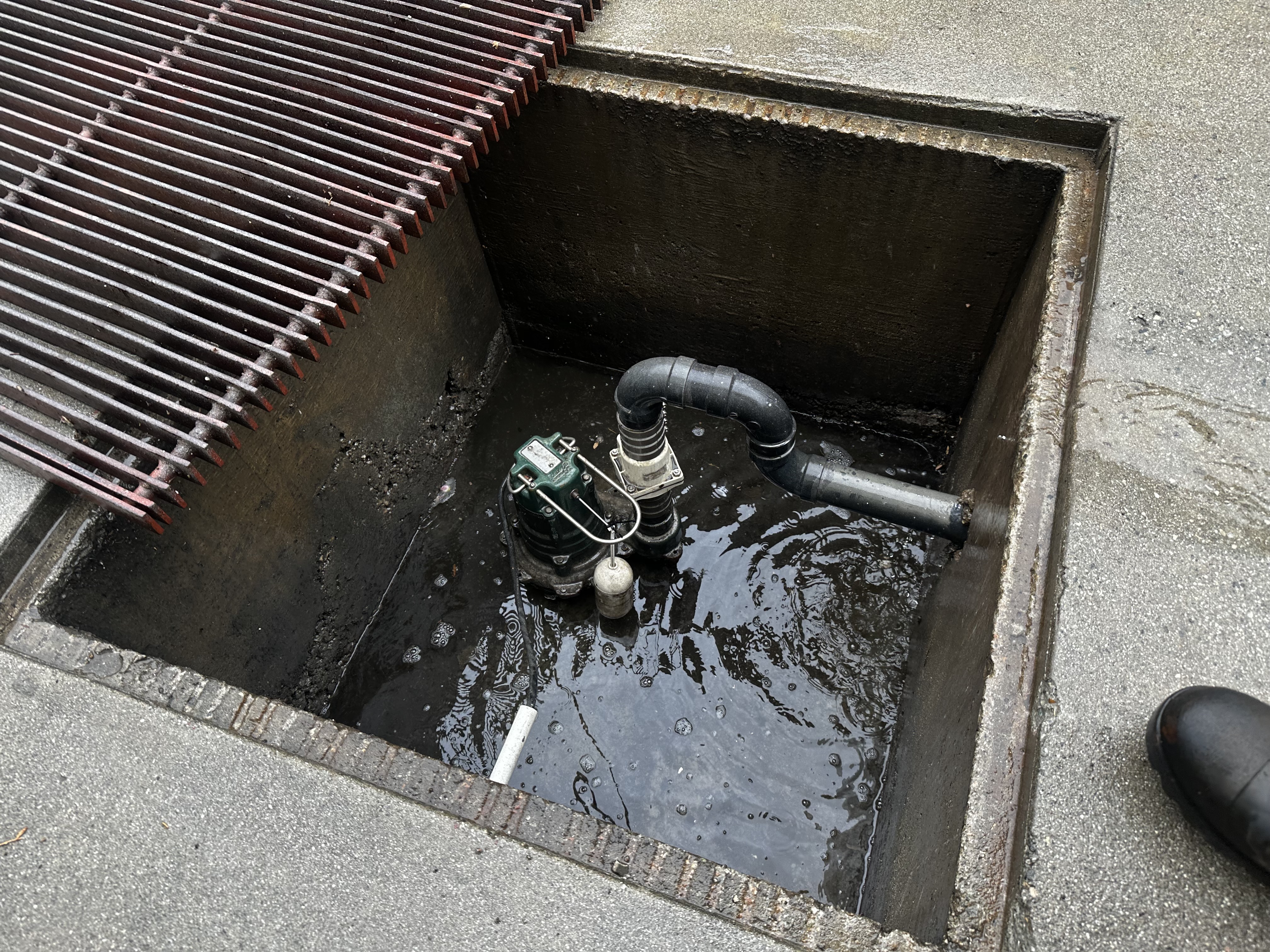
A sump pump that turns on isn't necessarily a drainage system that's ready for heavy rain.
That's an important distinction, especially in the South Bay, where a pump may sit relatively unnoticed through long stretches of dry weather. When significant rain finally arrives, the entire system has to work—from the drains collecting the water to the pump sending it safely away.
So how do you know if your sump pump is actually ready?
Test the system, not just the pump.
Start With the Whole Drainage System
When we evaluate a sump or stormwater pump system, we want to understand all of its parts:
Where does the water come from?
Are the drains open and flowing?
What condition is the pit in?
What type of pump is installed?
How is the pump activated?
Are there controls or alarms?
Where does the discharge go?
Can the complete system move water as expected?
That usually means inspecting and testing each part rather than simply lifting a float and confirming that the pump motor runs.
Where possible, we may use a sewer inspection camera to look inside the drain lines. We'll open the pit and check for excessive debris, muck or sludge. We'll identify the pump and understand how it is supposed to operate. If there's a control panel, we'll inspect and test the controls as appropriate.
Then we want to put water through the system and watch what actually happens.
A Pump Can Run and Still Have a Problem
One of the easiest assumptions to make is:
“I heard the pump turn on, so it's working.”
That's a useful first sign, but it doesn't tell us everything.
A pump could activate while the overall system is still struggling. We may find excessive debris in the pit, warning signs related to the pump's condition or age, problems with the controls, or unusual amounts of water remaining in the discharge piping.
We also pay attention to how water is moving.
Is the pump evacuating water efficiently? Does the pit empty as expected? Does the pump cycle normally? Does water return to the pit or remain where it shouldn't?
Individually, some of these observations may not mean a system is about to fail. Together, they help us understand its condition and identify issues worth addressing before the next storm.
Don't Test Only With a Garden Hose
Flow matters.
Running some water into a drain and seeing it disappear can tell you that there's a path for the water. It doesn't necessarily tell you how that drainage system will perform when considerably more water arrives.
When appropriate, we use hydro jetting equipment with higher flow rates while cleaning and testing drainage lines. That can give us a better starting point for observing how the system behaves under greater water flow than simply putting a garden hose down a drain.
We're not trying to recreate a particular rainstorm. We're looking at how the components interact when meaningful amounts of water move through the system.
Does water reach the pit properly?
Can the pump keep up?
Does the discharge system carry the water away effectively?
Those observations can tell us much more than simply confirming that a pump switches on.
A South Bay Pump That Was Working—But Not Efficiently
We recently evaluated a drainage system at a South Bay property with large pumps visible from above through a grate.
At first glance, the system appeared to work. The pumps activated and discharged water.
But during our diagnostics, we found a significant problem with the discharge piping.
A small amount of water from a properly designed weep hole was expected. What we found instead was a severely cracked section that was releasing roughly 30% of the discharged water.
The pump was running. Water was moving. But a substantial portion wasn't actually making it through the discharge system as intended.
In practical terms, the pump was working harder to remove less water.
We repaired the problem and continued testing the system.
That's a good example of why “the pump runs” isn't the end of a proper evaluation. Pumps, pits, drains, controls and discharge piping work together. A problem with one part can affect the performance of everything else.
What About Systems With Multiple Pumps?
If a property has two or more pumps, don't assume that seeing water discharge means every pump is operational.
Each pump should be verified.
Depending on the system, pumps may be designed to activate at different water levels or operate through a control panel. There may also be a high-water alarm intended to warn of abnormal conditions.
Knowing how the system is supposed to sequence is important. If only one pump has been doing all the work, that may not become obvious until incoming water exceeds what that pump can handle—or until it fails.
That's exactly the kind of discovery we'd rather make during testing than during heavy rain.
A Few Things Property Owners Can Know Before the Rain
You don't have to diagnose the entire system yourself, but knowing some basic information can be extremely helpful.
Start with the make and model of the pump. If possible, keep that information somewhere accessible.
Once a pump is submerged—or especially if it has failed underwater—it may be much harder to identify.
If your system has a high-water alarm, know where it is and how it's supposed to alert you.
For multiple-pump systems, know whether each individual pump has actually been tested. Seeing the system discharge water doesn't necessarily confirm that every pump works.
And pay attention to changes. A pit holding more water than usual, excessive debris or sludge, unusual cycling, alarms, or drainage that seems slower than it used to be are all reasonable reasons to investigate further.
Test Before You Need It
The best time to learn how a sump or stormwater pump system performs isn't when water is already rising.
Before heavy rain, the goal is to understand the system: inspect the drains, look at the pit, identify the pump, check the controls and alarms, examine the discharge, and put water through the system to verify how the pieces work together.
Sometimes that confirms everything is operating as expected.
Sometimes the system simply needs cleaning or maintenance.
And sometimes testing reveals a problem that wasn't obvious when the pump was sitting quietly—or even when it appeared to be working.
For South Bay homes and properties that depend on pumps to manage stormwater, that's the real question to answer before the rain:
Not just “Does my sump pump turn on?” but “Can my drainage system move the water where it needs to go when it matters?”
Published: October 9, 2026
Last reviewed: October 9, 2026
South Bay Drain Guide | Zoom Drain Los Angeles
Practical drain and sewer guidance for South Bay homeowners, businesses and property managers.