

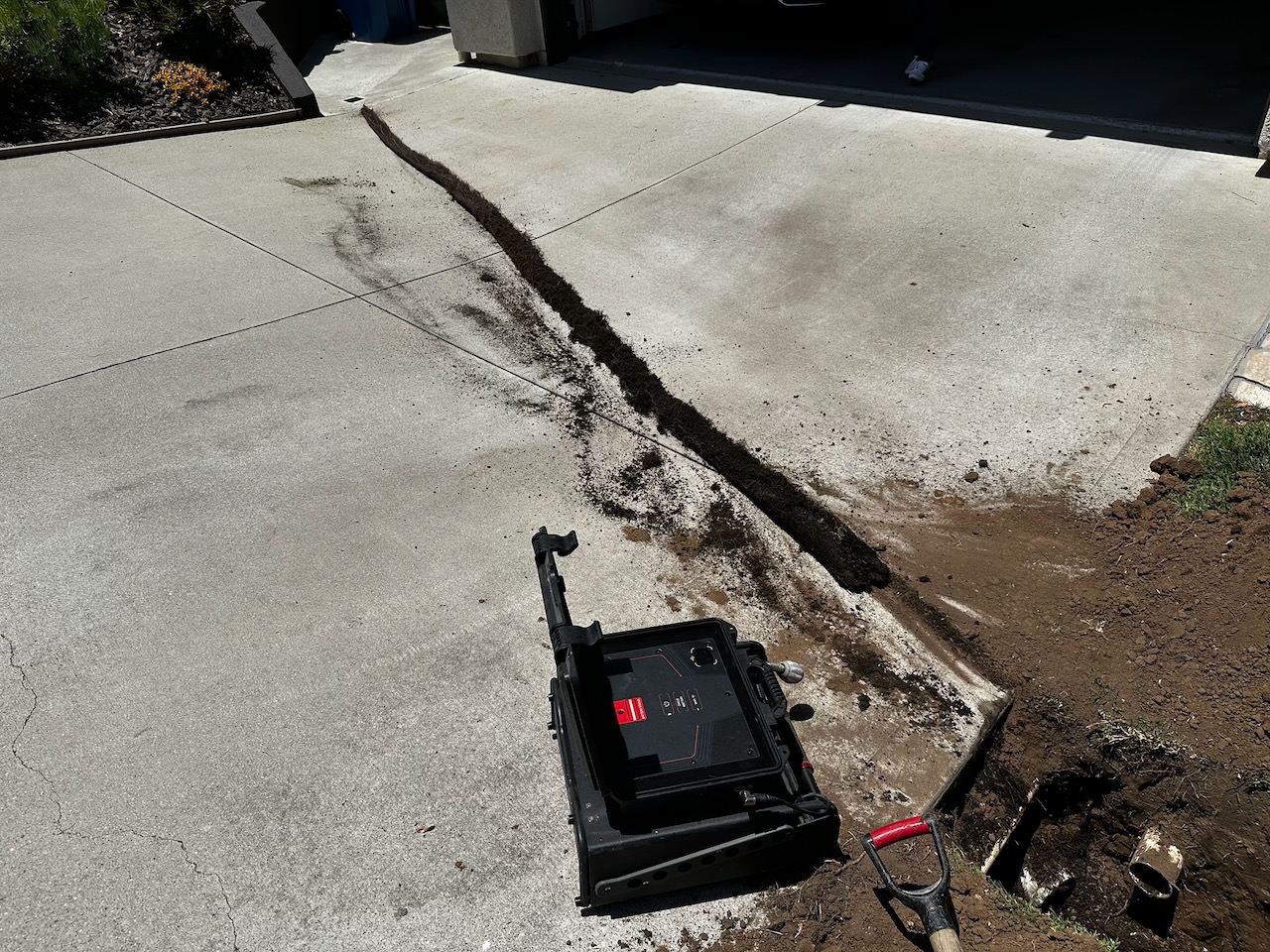
If an outdoor drain is slow, backed up, or holding water, how you clear it depends on where the restriction is and what is causing it.
Sometimes the problem is simple: leaves, dirt, or landscaping debris are covering a drain or filling a catch basin. Other times, debris has accumulated inside the pipe, roots have entered the line, or there is an obstruction farther downstream. And sometimes what looks like a clogged storm drain isn't really a clog at all.
The first question is where the water is supposed to go—and what is keeping it from getting there.
Start With What You Can See
Standing or pooling water is one of the most common reasons homeowners and property managers call us about an outdoor drain.
Before assuming the underground line is clogged, look at what's happening around it.
Is the grate covered with leaves or landscaping debris? Is the basin filled with dirt or sediment? Is water reaching the drain but not going down? Does it eventually drain if given enough time? Are several drains affected? And do you know where the system is supposed to discharge?
The history matters, too. If the same area has repeatedly held water, or the problem only appears during particularly heavy rain, that can tell us something different than a drain that suddenly stopped flowing altogether.
Around South Bay properties, long stretches of dry weather give leaves, dirt, roots, and landscaping debris plenty of time to accumulate unnoticed. The problem may not become obvious until rain finally puts the drainage system to work.
Clearing the Drain Starts With Finding the Restriction
If debris is covering the grate or filling an accessible basin, removing it may be enough to restore flow.
If the restriction is inside the line, the next step depends on what we find and what access is available.
A power snake can be useful for opening a path through certain stoppages. But opening a line and cleaning a line aren't necessarily the same thing. A snake may get water moving without removing all of the dirt, roots, sediment, or other material contributing to the restriction.
Hydro jetting is commonly useful for storm drains because high-pressure water can clean the pipe and pull accumulated debris back toward an accessible location instead of simply moving through it. That can make a significant difference in a line containing dirt and other loose material.
That doesn't mean every clogged storm drain needs hydro jetting. The type of obstruction, pipe condition, access, layout, and where the debris can safely go all matter. Sometimes snaking makes sense. Sometimes the basin simply needs to be cleaned. Sometimes hydro jetting is the better cleaning method. And sometimes the condition of the system tells us to investigate before doing more.
Test the System, Not Just the Drain
Once water starts moving, we test.
A drain accepting water is a good sign, but it doesn't necessarily tell us that the entire drainage system is working as it should. We want to know how the water moves through the system and whether it can move enough water for the job it is expected to do.
That can mean looking at how quickly a basin evacuates, whether other drains behave unexpectedly during testing, and whether water is actually reaching its intended discharge point.
A practical progression is often:
Observe → clear accessible debris → clean the line → test flow → investigate further if needed.
Not every property needs every step. What matters is following the evidence rather than assuming every standing-water problem has the same solution.
When something still doesn't make sense, further investigation might include a camera inspection, locating or tracing underground piping, evaluating the discharge point, or checking pumps and other components of the drainage system.
What If the Storm Drain Is Clear but Water Still Pools?
This is where the distinction between cleaning a drain and evaluating a drainage system becomes important.
A perfectly clean pipe can only move the amount of water its size, slope, layout, discharge, and other components allow it to move. Cleaning cannot correct inadequate capacity, poor grading, a damaged or offset pipe, an ineffective discharge point, or a pump that cannot move water quickly enough.
Recurring problems deserve particular attention. So do systems where something has changed over time.
For example, we evaluated a Redondo Beach property where the homeowner was concerned about standing water in a drainage basin. Some standing water itself wasn't necessarily abnormal. The more important observation was that the system wasn't evacuating water as effectively as expected.
The pumps had to move the water uphill over a considerable distance. Water remaining in the discharge piping was held by a check valve, so the pump had to work against that existing column of water each time it operated.
The pump could move the water—but the overall system wasn't doing it as effectively as it could.
Cleaning might improve a dirty line, but cleaning alone couldn't change that fundamental design condition. A more effective option was adding an intermediate basin and pump to divide the lift and help move the water through the property.
That's why simply asking, “Is the drain clogged?” doesn't always get to the real problem.
When Your Outdoor Drain Isn't Draining
If you notice standing water, start with what you can safely see. Keep the grate clear, look for obvious debris in accessible areas, and pay attention to how the water behaves.
Don't enter a basin, reach into inaccessible piping, or assume that because water eventually disappears the system is operating properly.
If the problem continues, the goal should be to understand the system before deciding on the solution. We want to see where the water comes from, where it is supposed to go, and what along the way is helping—or preventing—it from getting there.
Sometimes that's a simple cleaning. Sometimes it's snaking or hydro jetting. Sometimes further inspection reveals roots, damaged piping, an unknown discharge, a pump problem, or a system that isn't well matched to the water it needs to handle.
Our job is to understand what is happening, explain what we find, and give the property owner reasonable options for getting the drainage system working the way it should.
Frequently Asked Questions
Can I clear a storm drain myself?
You can safely remove leaves and other accessible debris from a grate and inspect an accessible basin for obvious buildup. If the restriction appears to be inside the underground piping, or the drain repeatedly backs up, professional cleaning and investigation may be appropriate.
Can you snake a storm drain?
Yes. Power snaking can be useful for certain storm-drain stoppages and may open a path through an obstruction. It does not necessarily clean all of the debris from the pipe, however, so the appropriate method depends on what is causing the restriction.
Does hydro jetting work on storm drains?
Yes, in appropriate conditions. Hydro jetting can be particularly useful for removing dirt, sediment, roots, and accumulated debris from storm-drain piping. Whether it makes sense depends on the pipe, access, obstruction, and overall drainage system.
What if the drain is clear but my property still floods?
The problem may be something other than a clog. Grading, drainage capacity, pipe slope or condition, the discharge point, and pump performance can all affect how quickly a property drains. If a clean system still cannot keep up with the water reaching it, the next step is to evaluate why.
Published: September 25, 2026
Last reviewed: September 25, 2026
South Bay Drain Guide | Zoom Drain Los Angeles
Practical drain and sewer guidance for South Bay homeowners, businesses and property managers.